


Having an active sourdough starter is essential to baking an amazing loaf of sourdough bread. This guide with walk you through step-by-step.
Things you will need
- Established sourdough starter - I purchased my starter dried from an online seller and then followed the included instructions to bring it back to life. You could have an active starter gifted to you from a friend, or you could make your own using flour, water, and time.
- Glass jar with a lid - you want a glass jar that is large enough for your starter to double or triple in size. The lid should never be screwed on tightly. I like Weck jars because they come with a glass lid that I just set on top. My favorite are these 1 liter glass jars.
- Unbleached flour - I like to use bread flour because it has a higher protein content but all-purpose flour will work as well.
- Warm water (between 75F and 100F) - Some say you should use only filtered spring water to make sourdough but it's really not that serious. I and many many others use tap water with no issues. Unless your tap water smells strongly of chlorine, it should be just fine.
- Kitchen scale - weighing everything in grams is essential for successful sourdough baking.
Tip: Keep a record of the weights in grams of your glass jars (without lids). This will make feeding your starter accurately so much easier. I have mine in a note on my phone.
How to feed your sourdough starter
Let's assume you have a starter and you have it established and ready to be fed in a glass jar.
Sourdough starter that is left out on the counter to ferment should be fed daily. My routine is to feed my starter first thing in the morning.
If your starter is left in the refrigerator, then it would go dormant and wouldn't need to be fed as often. This is for people who only want to bake once a week or less.
Sourdough starter is fed in ratios. Most people follow a 1:1:1 (starter:flour:water) feeding ratio. This means that if you have 50 grams of starter then you will feed that starter 50 grams of flour and 50 grams of water.
Some people feed at higher ratios like 1:2:2 or even 1:10:10! This means that if you have 50 grams of starter then you would feed it 100 grams of flour and 100 grams of water.
Higher feeding ratios slows down the fermentation process. It also keeps the starter from needing to be fed as often. Feeding the higher ratio before bed would mean your starter is ready to be used for baking in the morning.
You never want to feed your starter less than the amount of your starter. So if you have 50 grams of starter, do not feed it less than 50 gram of flour as this can lead to a sluggish starter.
Feeding your starter doesn't need to be complicated. Just remember if you feed your starter more flour (higher ratio) then it's going to take longer for your starter to peak.
Tip: You should rarely need to keep more than 50 grams of starter at one time. If fed a 1:1:1 ratio then you would end up with 150 grams of starter and that would be enough to bake a loaf of sourdough. Having more starter just means that you would need to use more and more flour to feed it everyday.
Let's feed your starter:
- Discard half of your starter (or more) - This doesn't have to be exact. Simply eyeball half of your starter and remove it from the jar. If you know your jars weight, you can weigh the jar with the remaining starter and subtract the weight of the jar to get your weight of starter.
- Add the flour and water - Depending on your feeding ratio, add your flour and warm water to the jar and stir well. Your result will be a thick pancake batter. Make sure there is no starter residue around the lid so it doesn't get stuck. Place the lid but do not screw it on.
- Place in a warm spot - If you're wanting to bake soon, you can place your starter jar in a warm spot in your kitchen, or in a proofing box. My oven has a Proof setting that I like to use. A cold kitchen will result in a slower ferment time.
- Wait - Your starter will be ready when it peaks. This can take anywhere from 4 -12 hours depending on the temperature of your kitchen and on your feeding ratio.
How do I know when my starter is ready?
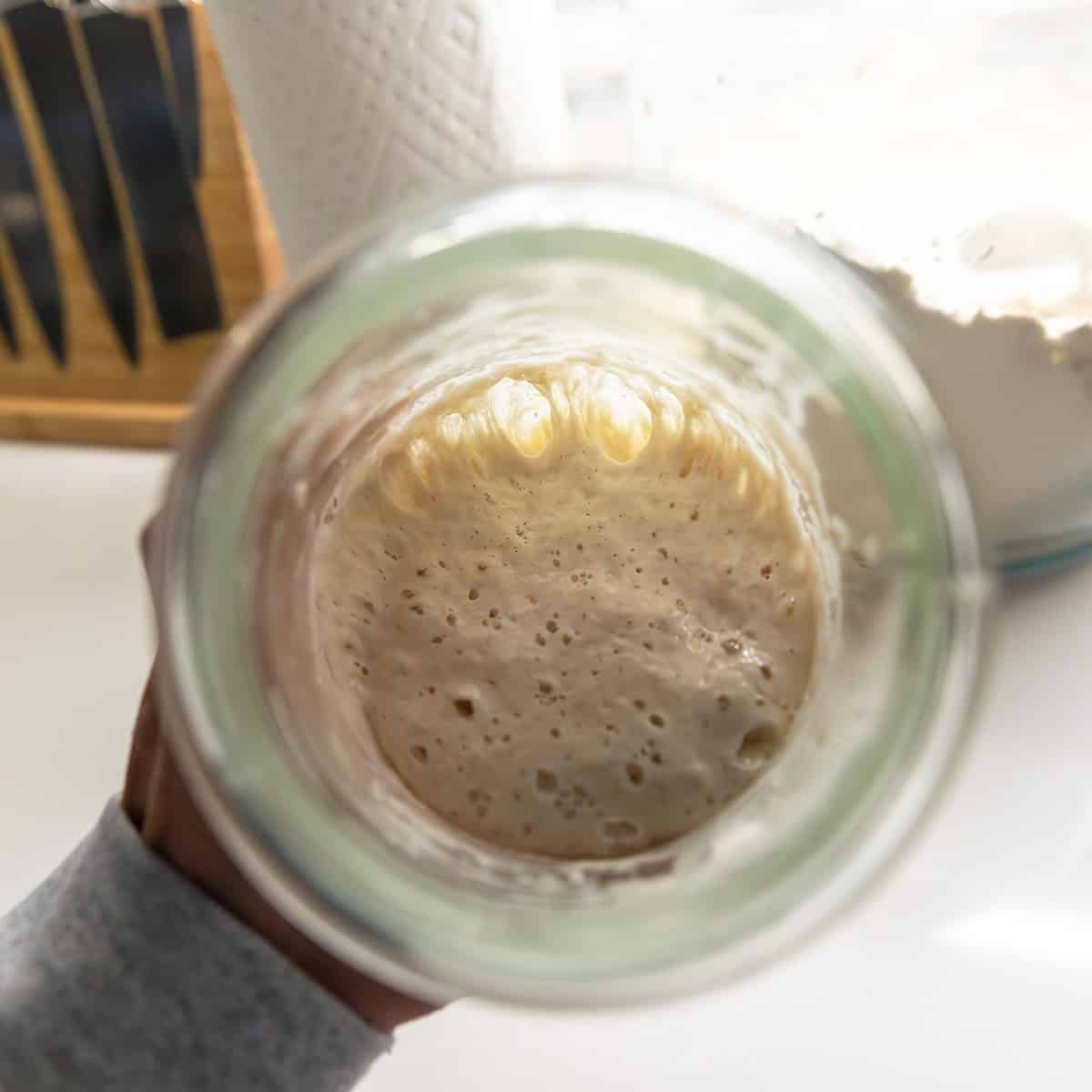
Your starter is ready when it has doubled in size and it is filled with bubbles. Also, the top will start to sink in a little. That means it has peaked and it is starting to deflate. Some people suggest the float test but this is not always accurate. I like to tilt my starter to the side and see the bubbles falling down in strings from the side of the jar.
How much starter should I keep daily?
You really only need a few grams of starter to keep it going daily. That is because the bacteria will multiply while it is consuming the new flour and grow your starter. Big jars of starter are not necessary unless you are baking multiple loafs per day. You can make 200 grams of starter in one day with only 10 grams to start if fed in a 1:10:10 ratio. This is enough starter for 2 loaves!
I personally keep 50 grams of starter on a day to day basis. This means I will discard all but 50 grams of my starter before I feed it. This will give me 150 grams after feeding a 1:1:1 ratio.
When should I feed my starter?
I always feed my starter first thing in the morning, even if I am not baking. My starter is usually ready before noon to start my sourdough. If you want to start baking first thing in the morning, you may try feeding your starter at night with a higher ratio so it is ready when you wake up.
What ratio should I use to feed my starter?
Most people swear by a 1:1:1 ratio and have used it for years with no issues. This ratio is great for beginners! Once you have established a routine and get a feel for your starter peaks, you can experiment with higher feeding ratios.
What if I accidentally miss a feeding?
No worries! Just get right back on schedule.
Can I keep my starter in the refrigerator?
Yes, but then your starter will be dormant. A couple of days before you want to bake, remove it from the refrigerator and do 2-3 peak to peak feeds to bring it back to life.
What is a sluggish sourdough starter?
A sluggish starter is one that is not doubling after a feeding or taking a very long time. I would suggest feeding this starter twice a day for a couple of days or feeding at a higher ratio to bring it back to life. It could also be that your water has too much chlorine and that is killing off the bacteria in your starter.
How should my starter smell?
The way your sourdough starter smells is a great indication of its health. Your starter should smell yeasty or if you fed it recently, like flour. If your starter smells acidic, that means that it is hungry and needs to be fed. If it smells acidic in-between routine feeds, you may want to feed it a higher ratio.
How long do I have to bake after my starter peaks?
Don't worry, you do not need to be watching your starter like a hawk to catch it right after it peaks. You definitely have a couple hours to work with.
What do I do with the discard?
I usually just throw my sourdough discard in the trash but it can be stored in the refrigerator in an airtight container. It can be used to make a whole host of sourdough discard recipes.
My feeding routing when baking a loaf of bread
When I wake up at around 6:30AM, I discard all but 50 grams of starter from my jar. Then I will feed it 50 grams of flour and 50 grams of water. I stir it well and then place it in my oven with the proof setting turned on. This keeps my starter at around 80F degrees.
Usually around noon my starter is ready to be used. I scrape out a little less than 150 grams of starter into a bowl to make my sourdough. This is enough starter to make 2 loaves of bread (the less starter you use, the longer it takes to ferment, and the more sour your loaf will be).
There will be a little bit of starter left in the jar - like 15-20 grams. I feed that some flour and water and now my starter is all set to grow again.
Is sourdough bread low carb?
No, sourdough bread is not low carb but some people love to eat it for the gut healthy benefits. Sourdough bread does have a lower glycemic index than traditional bread as well.
BK Ng says
I like this simple step-to-step 'coaching' for beginner like me.
While I love cooking, I hardly lay my hands on bakery which requires more precise recipe.
With the above guidance, it renew my passion to make my own sourdough.
Thank you again, Editor Guru.
Thank you